
Common Door Closer Problems in Busy Burnaby Commercial Buildings
A door closer is the most used piece of hardware in most commercial buildings and the least thought about. It works several hundred times a day in a busy entrance, it is bolted somewhere above eye level, and nobody looks at it until the door starts slamming or stops latching.
By then it has usually been failing for weeks. Closers rarely break suddenly. They drift out of adjustment, leak, or get overloaded by a door they were never sized for, and the symptoms are easy to read once you know what each one means.
What a Closer Is Actually Doing
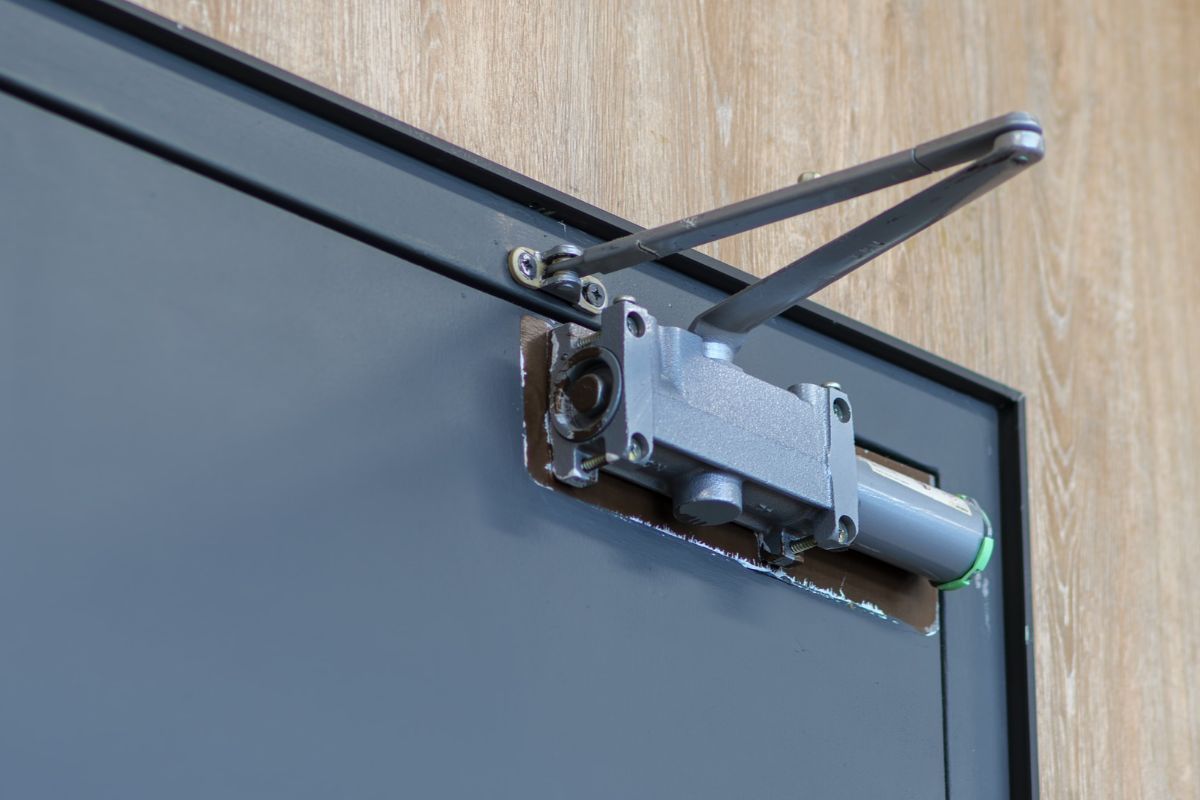
A hydraulic closer stores energy in a spring when the door is opened and releases it through a valved oil circuit on the way back. The spring decides how hard the door pushes closed. The valves decide how fast it travels at different points in the swing.
Most surface-mounted closers have at least three separate adjustments: the main closing speed through the bulk of the arc, the latch speed over the last few inches, and a backcheck that slows the door near the end of the opening swing to stop it slamming into a wall. Many have an adjustable spring power as well, and some add a delayed action that holds the door open briefly before closing.
Almost every complaint about a commercial door traces back to one of those settings being wrong, the closer being undersized for the door, or the oil circuit having failed.
The Door Slams
This is the most common call, and the most commonly misdiagnosed. People assume the closer is too strong when the usual culprit is latch speed set too fast.
A properly adjusted door travels at a steady pace through most of the swing and then slows over the last few inches so it meets the frame quietly and still latches. If the final section is left wide open on the valve, the door accelerates into the frame. The noise is the symptom, but the real damage is cumulative: hinges loosen, the frame deforms slowly, glazing stops take a beating, and in a fire-rated assembly the latch hardware wears faster than it should.
Spring power set too high produces the same noise and a second problem, which is that the door becomes hard to open. That matters beyond comfort, because building code limits how much force may be required to open a door on an accessible route. Cranking spring power up to force a stubborn door closed is a frequent way for a building to fall out of compliance without anyone realising.
The Door Does Not Latch
The opposite complaint, and in a commercial building the more serious one. A door that stops short of the latch is a security problem, an energy problem, and in the case of a fire separation a code deficiency.
Several causes produce the same result:
- Closing force reduced too far, often after a complaint that the door was hard to open
- A closer undersized for the width and weight of the door, which is common after a door is replaced with a heavier one and the old closer is reused
- Worn or binding hinges that add friction the closer was not sized to overcome
- Air pressure working against the door, which is routine in high-rise lobbies, stairwells and vestibules where mechanical systems and stack effect create a pressure difference
- Weatherstripping or a new sweep adding resistance at the last inch of travel
- A misaligned strike, so the latch bolt catches instead of entering cleanly
The order of investigation matters. Adjusting the closer to overcome a hinge problem or a misaligned strike treats the symptom and shortens the life of the hardware. On an exterior door in a tall building, pressure is worth checking before anything is adjusted at all, because the door may behave differently depending on the season and what the mechanical system is doing.
The Closer Is Leaking Oil
A film of oil on the closer body or a stain running down the door is the one symptom that is not an adjustment problem. The hydraulic seal has failed, and once the fluid is going there is no putting it back.
A leaking closer loses control gradually. The door starts closing unevenly, then too fast, then stops controlling at all. There is no field repair for a sealed hydraulic body on the closers used in most commercial applications, so the correct answer is replacement, ideally before the door is slamming.
It is worth finding out why it failed rather than simply fitting the same unit again. Closers leak early when they have been forced past their stop, mounted on a frame without proper reinforcement, or sized below the door they are controlling. Replacing like for like on an oversized door just restarts the clock. Our door repair and maintenance work usually starts with that question rather than with the part.
The Door Opens Too Far
Holes in drywall behind a door handle, a bent arm, or a closer that has torn loose from its mounting are all signs that nothing is stopping the door at the end of its swing.
Backcheck is the setting that cushions the last part of the opening arc, and it is frequently left at the factory position. In a windy entrance or a high-traffic corridor where people push doors hard, that is not enough on its own. A door that opens into a wall needs a physical stop as well, either an overhead stop or a floor stop, because backcheck slows a door and does not hold it.
Burnaby entrances see this more than most. An exposed storefront on a windy corner, a loading entrance, or a lobby door that catches wind funnelled between towers will all overtravel repeatedly, and the arm or the mounting fails before the closer does.
Fire Doors Are a Different Standard
On a rated fire separation, the closer is part of the assembly rather than a convenience. The door has to self-close from any open position and positively latch without assistance, and the BC Fire Code requires fire separations and their closures to be maintained in working order.
The failures found in practice are mundane and all of them are deficiencies: a door wedged open because it was slamming, a hold-open device fitted to a door that is not permitted to have one, a closer disconnected after someone complained about the opening force, a latch that no longer engages because the closer is weak. Each one is cheap to correct and expensive to be cited for.
If a rated door in your building does not close and latch on its own every time, it needs attention before the next inspection rather than after it. Fire-rated door supply, installation and service exists for exactly this, and the fix is often hardware rather than the door.
Why High Traffic Changes the Maintenance Math
A residential door closer might cycle a few times a day. An entrance at a Metrotown-area retail unit, a medical office, a school or a busy industrial building can cycle hundreds of times, which compresses years of wear into months.
Two consequences follow. The first is that adjustment drifts, so a closer that was set correctly in spring will often need checking by autumn. The second is that the surrounding hardware wears alongside it. Hinges, strikes, thresholds and weatherstripping all affect how the closer behaves, which is why adjusting the closer in isolation on a worn door rarely holds.
Temperature is the seasonal variable people notice without identifying. Hydraulic oil thickens in cold weather and thins in heat, so the same closer runs slower in January than in July. A door set up perfectly on a warm day may stop latching in a cold snap. Closers with temperature-stable fluid reduce this, and on an exterior door in a climate like ours they are worth the difference.
What a Sensible Maintenance Routine Looks Like
Door closers are one of the few building components where a short scheduled check prevents nearly all emergency calls.
Twice a year on high-traffic doors, someone should confirm that each door closes fully and latches from a fully open position, check that the opening force is still reasonable, look for oil on the body and arm, confirm mounting screws are tight, and verify that every rated door self-closes and latches with nothing holding it open. Anything unusual gets noted rather than adjusted on the spot, because a door that needs constant adjustment usually has a different underlying problem.
Where a door has reached the point of needing a new closer, it is worth looking at the hardware as a set rather than a single part. Commercial door hardware chosen to match the door weight, the traffic and the exposure lasts considerably longer than a closer fitted to whatever was already there.
Talk to Doormate
Doormate services and installs commercial doors across Burnaby and the Lower Mainland, including closers, hardware, steel doors, fire-rated assemblies and custom work, with a 24-hour line for doors that cannot wait.
If a door in your building is slamming, sticking, leaking or failing to latch, tell us what it is doing and we will tell you whether it is an adjustment, a hardware problem or a replacement. Call 778-998-7480 or get in touch.